How a Silent Running Toilet Quietly Spikes Your Monthly Isanti County Utility Bill
A silent running toilet is one of the easiest ways to watch money disappear without seeing a puddle. No mess on the floor, no dripping under the sink, no obvious “emergency.” Just a steady trickle from the tank to the bowl that quietly bumps your usage until your monthly statement shows up looking wrong.
If you’re in Isanti County or the North Metro, that “mystery” increase is usually one of two things: seasonal outdoor use, or a toilet that never fully stops filling. The good news is you can confirm it quickly and fix it in most cases with a few basic parts. If it’s not basic, you want a clean, predictable service call that protects your schedule and your client’s home.
Why a “Quiet” Running Toilet Becomes an Expensive Utility Problem
The leak you don’t hear is the one that hurts
Not every running toilet sounds like Niagara. Some leak through the flapper so slowly that the only “noise” is the fill valve kicking on every 10–30 minutes. That’s easy to miss in a busy household, and it’s even easier to miss on a job site when the home is vacant between trades.
Why it shows up as a “mystery” bill increase in Isanti County
Most homeowners notice the bill before they notice the toilet. Your water provider doesn’t know you have a flapper leak, they just see higher gallons. If sewer is billed off water usage (common in many setups), the cost impact can be worse than people expect. There’s no money in the water, and there’s no upside to letting it run.
Running Toilet Water Bill Math: What a Small Leak Can Cost
Here’s the part that gets attention: a “small” leak isn’t small when it runs 24/7.
Common leak rates (and what they mean monthly)
Intermittent refill (fill valve cycles every 10–30 minutes): often hundreds to a few thousand gallons per month.Slow flapper seep (steady trickle into bowl): commonly 3,000–10,000+ gallons per month depending on severity.Stuck-open fill valve (water constantly into overflow): can exceed 10,000–20,000+ gallons per month.
Exact rates depend on your toilet model and how the leak presents, but the pattern is consistent: time is what makes it expensive.
A quick way to estimate your own cost
If you know your cost per 1,000 gallons (water + sewer), you can estimate the running toilet water bill impact like this:
Monthly cost impact ≈ (extra gallons ÷ 1,000) × (your $/1,000 gallons)
Even if you’re not sure of the exact rate, the gallons are the real problem. A toilet leaking 10,000 gallons in a month is 10,000 gallons you paid for and got nothing back.
Why sewer charges often make it worse
Many people think, “It’s just water.” But if your billing ties sewer fees to water usage, every extra gallon can effectively get charged twice. That’s why one bad toilet can make an otherwise normal month look like a lawn-watering month.
How to Confirm Your Toilet Is Running (Without Guessing)
Food coloring test (10 minutes)
Remove the tank lid carefully and set it somewhere safe.Add a few drops of food coloring to the tank water.Don’t flush. Wait 10 minutes.If color shows up in the bowl, you have a leak from tank to bowl.
This is the simplest proof for a flapper/flush-valve issue, and it works even on silent leaks.
Water meter test (best for whole-house confirmation)
If you want to confirm a leak anywhere in the home:
Turn off all fixtures and appliances that use water.Check the water meter leak indicator (often a small triangle or dial).If it’s moving, water is flowing somewhere.
If the meter is moving and the toilet is your suspect, shut off the toilet angle stop for 15 minutes. If the indicator stops, the toilet is the culprit.
Signs remodelers and builders should flag during walkthroughs
Random refills while no one has used the bathroom.Water movement in bowl that looks like a constant shimmer.Staining at the waterline that returns quickly after cleaning.
These are the kind of tiny details that turn into callbacks if they’re missed at turnover.
The Usual Culprits: What Actually Fails Inside the Tank
Flapper and flush valve seat wear
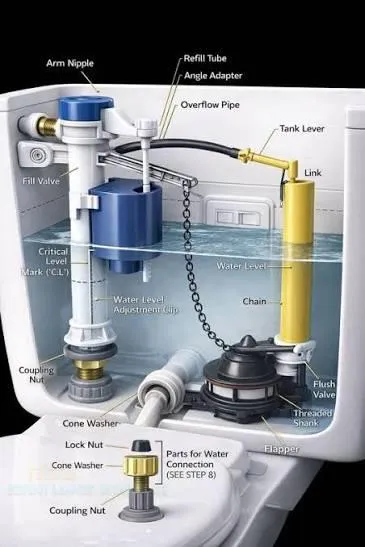
The flapper is a wear item. Rubber hardens, warps, or gets mineral buildup. If the flapper can’t seal against the flush valve seat, water leaks into the bowl and the fill valve keeps topping off.
Fill valve drift and overfilling
If the fill valve is set too high, or if the float isn’t shutting it down cleanly, water runs into the overflow tube. This can be nearly silent because the overflow route is designed to be smooth and controlled.
Chain, handle, and alignment issues
A chain that’s too tight can hold the flapper open just enough to leak. A handle that sticks can do the same thing. These are simple fixes, but they’re easy to miss if you only look for “broken parts.”
Cracked overflow tube or tank-to-bowl leak
Less common, but real: a cracked overflow tube or internal porcelain issues can create odd, intermittent behavior. Tank-to-bowl hardware failures can also cause slow leaks and staining. When you’re replacing parts and the problem won’t quit, it’s time to stop guessing and get eyes on it.
DIY Fixes That Usually Work (and the Ones That Waste Time)
Fast flapper replacement checklist
Confirm the correct flapper model and size before installing.Clean the flush valve seat gently, removing mineral or grit buildup.Set chain slack so the flapper closes fully after every flush.Re-test with food coloring to confirm a full seal.
A flapper swap is often the highest ROI fix for a running toilet water bill problem.
Fill valve adjustment or swap
Set the water line below the top of the overflow tube.Verify the float moves freely and shuts off consistently.Replace a noisy, sticking, or old fill valve rather than fighting it.
If the toilet is older or the fill valve is original, replacement is typically faster than repeated adjustments.
When to stop and call a pro
You replaced the flapper and the leak test still fails.The tank hardware is corroded, seized, or dripping externally.You have multiple toilets showing issues at once on a project.
This is where “DIY until it works” starts costing more than a clean service call.
Builder and Remodeler Angle: Why This “Small” Fix Protects Your Reputation
Client trust and warranty callbacks
If a homeowner moves into a fresh remodel and the first thing that hits is an unexpected high utility bill, they don’t care that the countertop install went perfect. Their brain goes to “something wasn’t done right.” Even when it’s a $15 part, it can feel like a quality issue.
Punch-list efficiency with a ‘No Chaos’ partner
Most GCs aren’t worried about whether a flapper is complicated. They’re worried about the chaos: missed windows, messy work, and having to chase someone for updates. Our approach at MH Plumbing is built around removing that stress:
Respect the schedule with on-time arrivals and clean time windows.Respect the home with job site cleanliness and careful protection.Transparent communication so you’re not guessing what changed.
Documenting fixes with before-and-after proof
When it matters, we’ll show the homeowner and the GC what we found and what we fixed. Before-and-after job site videos and clear notes reduce finger-pointing and help everyone move forward.
When to Call MH Plumbing in the North Metro
If the bill jumped and you need answers fast
If a homeowner in Isanti County calls you with a bill spike, you want a solution that’s quick, documented, and clean. We can verify the leak source, fix what’s actually failing, and leave the space spotless.
If the toilet is older, commercial-grade, or frequently used
High-use bathrooms, older fixtures, and non-standard parts can turn a simple fix into a time sink. We keep it straightforward: diagnose, quote transparently, and get it handled without dragging the project timeline.
What our ‘No Chaos’ service looks like on-site
Clear arrival windows with proactive updates.Clean work habits that don’t create homeowner complaints.Transparent pricing and a direct explanation of the fix.
If you’re a North Metro remodeler or builder and you want a plumbing partner who protects your reputation, that’s our lane.
FAQ: Running Toilet Water Bill Questions We Hear All the Time
Can a running toilet really double a bill?
Yes, especially if the toilet is sending water down the overflow tube continuously or if the leak runs all day for weeks. The scary part is it can happen without any obvious sound.
Will a running toilet affect hot water or heating bills?
Usually it’s cold water only, so it hits water and sewer charges, not your water heater. The exception is a fixture plumbed in an unusual way, but for a standard toilet, you’re looking at utility usage, not heating load.
Is it safe to use the toilet while it’s leaking?
Most of the time, yes. It’s just wasting water. If the tank is overflowing onto the floor or you see moisture at the base, shut off the toilet angle stop and address it right away to prevent property damage.
What does it mean if I see ‘tan’ buildup and how do I fix a leaking toilet tan ring?
That tan ring is often mineral staining (iron, manganese, hardness) and it can get worse when fresh water is constantly moving through the bowl. If you’re searching fix a leaking toilet tan, the real play is two-part:
Fix the leak first by replacing the flapper or correcting the fill level.Then clean the stain with a non-abrasive bowl cleaner suited for mineral deposits.Prevent the return by confirming the toilet stops refilling between uses.
If the stain keeps coming back fast, it’s a clue that water is still moving when it shouldn’t be.
